Memorial Day, May 30, is a day to remember the more than one million men and women who died in military service to the USA. The flag is a symbol of the freedoms they fought for, which we enjoy today. This twister quilt sparkles with red, white and blue pinwheels which are beautifully framed by a bunting border print.
Long May You Wave by Judy Pedersen
If you would like to make your own flag quilt for patriotic holidays, check out our Free Pattern Day for Patriotic and Flag Quilts:
Image credits: The quilt by Judy Pedersen was photographed by Quilt Inspiration at the 2016 Arizona Quilters' Guild show.
Sunday, May 29, 2016
Monday, May 23, 2016
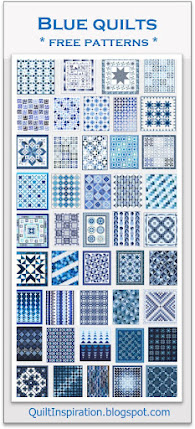
Free pattern day! House quilts
We've got dozens of FREE house quilt patterns... which ones will you choose? NOTE: This post has been UPDATED. For the latest Free Pattern Day for House Quilts, CLICK HERE!
p.s. Check out our E-Bay shop for great bargains on patterns, clothing, jewelry, and collectibles! For continuous free quilt patterns, please visit us on Twitter !
Image credits: Note: This post was updated on January 16, 2026. All images are copyrighted by their owners. Please respect their generosity in sharing their free patterns, and the restrictions they have placed on the use of these designs. If any links are broken, we'd love to know so we can fix it; email us at quiltinspiration {at} gmail {dot} com.
Monday, May 16, 2016
World Painters Challenge / 2
If you were asked to create a work of fiber art representing a work of a famous painter, or to make a design of your own choice in the style of that painter, what would you create? This World Painters Challenge was issued to groups of quilters in Japan, France and the U.S (for details, scroll to the bottom of this post.) This outstanding exhibit is touring AQS QuiltWeek throughout 2016; here is Part 2.
Jan Potter selected a portrait that Pablo Picasso did of his friend, the photographer Dora Maar, in 1937. Jan tried to feature the simplicity of style that Picasso used in creating two aspects of the face simultaneously: both facing the viewer and in profile. Jan's techniques include raw edge applique, hand and machine stitching, textile paints, stamping, and surface embellishment.
In this interpretation of Monet's "Water Lilies", Mireille Schaal focused on placing bright spots of blue and green hues, with a touch of pink here and there to capture the look of blossoms on the pond. Mireille's techniques and materials include silks, laces, ribbons, tulle overlay, free motion quilting, machine applique, hand embroidery, and acrylic paint.
Linda M. Steller writes, "I chose Dance from Mucha's The Arts series. As a longarm quilter, I love the long flowing lines of many of Mucha's works, especially the hair of many of his female subjects. I used powdered pigments mixed with fabric medium for the base painting and then shaded in with Derwent Inktense Pencils. I love how the color blooms when those pencils are exposed to moisture."
Bethanne Nemesh states, "Many of Degas' ballerinas were painted at practice, at rest, or when they were socializing before a performance. My ballerina captures this same feeling in her resting stretch. I used a two tone wholecloth approach: one to capture the ballerina and the other to place her, as if she were actually.....a painting, in a gilt frame. The fabric is silk dupioni with polyester and silk threads. "
For her subject, Maki Shimada chose the cherry blossoms featured by the artist Utagawa Hirosige. Because Maki lives close to the house where Hiroshige used to live, she feels as if she and the painter have seen the same cherry trees. Maki notes that in creating this work, she felt the superb elements of nature.
Kuniko is impressed with the ability of the painter Eitoku, who lived from 1476 to 1559 and created Chinese-style figures of lions. Eitoku was an artist on retainer to two warlords, Nobunaga Oda and Hideyosi Toyotomi; and his works flourished in their service. Eitoku was given both Oda's and Toyotami's crest of family in appreciation for his work. Kuniko admires the heroism of both warlords in this turbulent time in Japan's history.
Daphne W. John explains, "I begin a project with a specific idea or theme in mind. The final result may be quite different as the fabric has a way of shaping itself and saying to me, 'Nope - try it another way!' I find it very difficult to define 'art'. If pundits throughout the ages haven't been able to agree on a definition, why should I try? My hope is that my work will cause the viewer to think, to laugh, to feel something!"
Ginny Steller says that although some of Joan Miro's artwork is childish with a sinister twist, she wanted to represent his work in a lighter moment. She used dark lines, solid colors, and defined shapes. Ginny wishes a very happy day in the garden to the kitty cat shown here.
This work by Yolande Guibert features the French post-impressionist painter Paul Cezanne, who painted Mount Sainte-Victoire, in the Provence region of southern France.
Chantal Gruais wanted to highlight the tastes and themes of the French painter Raoul Dufy, who liked to depict music, horses, racetracks, and open-air scenes of nature, such as golden wheat fields.
Image credits: Photos were taken by Quilt Inspiration at the 2016 AQS QuiltWeek in Phoenix, Arizona.
Pablo Picasso
Jan Potter, Oregon
Jan Potter selected a portrait that Pablo Picasso did of his friend, the photographer Dora Maar, in 1937. Jan tried to feature the simplicity of style that Picasso used in creating two aspects of the face simultaneously: both facing the viewer and in profile. Jan's techniques include raw edge applique, hand and machine stitching, textile paints, stamping, and surface embellishment.
Claude Monet
Mireille Schaal, France
In this interpretation of Monet's "Water Lilies", Mireille Schaal focused on placing bright spots of blue and green hues, with a touch of pink here and there to capture the look of blossoms on the pond. Mireille's techniques and materials include silks, laces, ribbons, tulle overlay, free motion quilting, machine applique, hand embroidery, and acrylic paint.
Alphonse Mucha
Linda M. Steller, Oregon
Linda M. Steller writes, "I chose Dance from Mucha's The Arts series. As a longarm quilter, I love the long flowing lines of many of Mucha's works, especially the hair of many of his female subjects. I used powdered pigments mixed with fabric medium for the base painting and then shaded in with Derwent Inktense Pencils. I love how the color blooms when those pencils are exposed to moisture."
Edgar Degas
Bethanne Nemesh, Pennsylvania
Bethanne Nemesh states, "Many of Degas' ballerinas were painted at practice, at rest, or when they were socializing before a performance. My ballerina captures this same feeling in her resting stretch. I used a two tone wholecloth approach: one to capture the ballerina and the other to place her, as if she were actually.....a painting, in a gilt frame. The fabric is silk dupioni with polyester and silk threads. "
Utagawa Hiroshige
Maki Shimada, Japan
For her subject, Maki Shimada chose the cherry blossoms featured by the artist Utagawa Hirosige. Because Maki lives close to the house where Hiroshige used to live, she feels as if she and the painter have seen the same cherry trees. Maki notes that in creating this work, she felt the superb elements of nature.
Kanou Eitoku
Kuniko Saka, Japan
Kuniko is impressed with the ability of the painter Eitoku, who lived from 1476 to 1559 and created Chinese-style figures of lions. Eitoku was an artist on retainer to two warlords, Nobunaga Oda and Hideyosi Toyotomi; and his works flourished in their service. Eitoku was given both Oda's and Toyotami's crest of family in appreciation for his work. Kuniko admires the heroism of both warlords in this turbulent time in Japan's history.
Marc Chagall
Daphne W. John, Oregon
Daphne W. John explains, "I begin a project with a specific idea or theme in mind. The final result may be quite different as the fabric has a way of shaping itself and saying to me, 'Nope - try it another way!' I find it very difficult to define 'art'. If pundits throughout the ages haven't been able to agree on a definition, why should I try? My hope is that my work will cause the viewer to think, to laugh, to feel something!"
Joan Miro
Ginny Steller, Oregon
Ginny Steller says that although some of Joan Miro's artwork is childish with a sinister twist, she wanted to represent his work in a lighter moment. She used dark lines, solid colors, and defined shapes. Ginny wishes a very happy day in the garden to the kitty cat shown here.
Paul Cezanne
Yolande Guibert, France
This work by Yolande Guibert features the French post-impressionist painter Paul Cezanne, who painted Mount Sainte-Victoire, in the Provence region of southern France.
Raoul Dufy
Chantal Gruais, France
Chantal Gruais wanted to highlight the tastes and themes of the French painter Raoul Dufy, who liked to depict music, horses, racetracks, and open-air scenes of nature, such as golden wheat fields.
The World Painters Challenge
Image credits: Photos were taken by Quilt Inspiration at the 2016 AQS QuiltWeek in Phoenix, Arizona.
Thursday, May 12, 2016
World Painter's Challenge / 1
If you were asked to create a work of fiber art representing a work of a famous painter, or to make a design of your own choice in the style of that painter, what would you create? This World Painters Challenge was issued to groups of quilters in Japan, France and the U.S (for details, scroll to the bottom of this post.) This outstanding exhibit is touring AQS QuiltWeek throughout 2016.
Image credits: Photos were taken by Quilt Inspiration at the 2016 AQS QuiltWeek in Phoenix, Arizona.
Katsushika Hokusai
Gustav Klimt
Pierre Renoir
Henri Matisse
Joan Miro
Andy Warhol
Georgia O'Keefe
Henri Rousseau
Paul Gauguin
Edgar Degas
About the World Painters Challenge
Image credits: Photos were taken by Quilt Inspiration at the 2016 AQS QuiltWeek in Phoenix, Arizona.
Subscribe to:
Comments (Atom)